|
|
| |
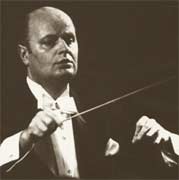
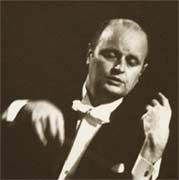
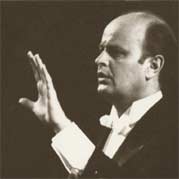
1948-1958 Ferenc Fricsay, First Chief Conductor of the RIAS Orchestra,
today’s “dso” (Deutsches Symphonie Orchester Berlin )
| 1948 |
Elsa Schiller, in charge of the sector Serious Music of the RIAS, is in search of a chief conductor for the RIAS-Symphony Orchestra. At the Salzburger Festspielen she meets the young Hungarian conductor Ferenc Fricsay and is able to convince him to accept an appointment . A parallel contract as Chief Conductor ties Ferenc Fricsay to the RIAS-Symphony Orchestra and to the Städtische Oper (today Deutsche Oper Berlin), which at the time is still residing in the Theater des Westens.
|
12.12.1948
|
First concert with Ferenc Fricsay in the Titania Palast
|
| Sept. 1949 |
The first recording, Tchaikowsky’s Violin Concerto with Yehudi Menuhin and Ferenc Fricsay is produced in the Jesus-Christus Kirche in Berlin-Dahlem.
|
| 1951 |
Contract between Fricsay and the Deutsche Gramophon Gesellschaft
|
| 1951 |
First tour in West Germany. As an ambassador of culture, coming from the divided Berlin, the RIAS-Symphony Orchestra is often received as a guest at Festivals for contemporary music. In choosing his programs, Ferenc Fricsay’s favourites are: Wolfgang Amadeus Mozart, Béla Bartók and Zoltán Kodály. In nearly all his concerts, he introduces a contemporary composer or he conducts concerts entirely with new music. Names such as Bartók, Berg, Blacher, Hindemith, Schönberg or Stravinsky are not yet common in concert life, and so the orchestra gives many works a première or even a world première. This is how it establishes its specific tradition as one of the world leading ensembles for contemporary music. The instrumental soloists are, among others, the pianists Géza Anda, Claudio Arrau, Walter Gieseking, Friedrich Gulda, Margrit Weber and Clara Haskil; the violinists Yehudi Menuhin, Wolfgang Schneiderhan and Tibor Varga, as well as the cellist Pierre Fournier. A particularly close working relationship develops between Fricsay and the singers Dietrich Fischer-Dieskau, Josef Greindl, Maria Stader und Ernst Haefliger.
|
| 28.2.1952 |
Première in West Germany of of Alban Berg’s violin concerto with the violinist Rudolf Schulz (World premiere at the ISCM Festival in Barcelona 1936 on April 19th conducted by Hermann Scherchen, soloist Louis Krasner).
|
| 1952 |
Concert tour to Paris
|
| 1953 |
Americans cancel their financial support for the RIAS-Symphony-Orchestra. Musicians establish a Civil Law Company and appoint solo flautist Heinz Hoefs as the director.
|
| 1954 |
Fricsay terminates his contract as musical director of the RIAS-Symphony-Orchestra, but he keeps his close ties to the orchestra. In the 1950s the orchestra plays under such famous conductors as Karl Böhm, Georg Solti and Otto Klemperer. Besides, conductors of a new generation, Wolfgang Sawallisch, Bernhard Haitink and Lorin Maazel are now at the conductor’s desk.
|
| 1956 |
The RIAS is re-named to Radio-Symphonic-Orchestra. The Studio Free Berlin signs a production contract with the orchestra, but stipulates the change of name. The short form RSO is kept. Wolfgang Streseman becomes the first RSO Director (until 1959).
|
| 1957/58 |
Several recordings are made under Ferenc Fricsay (a.o. Bártok "Konzert für Orchester" and "Herzog Blaubarts Burg", Mozart: "Don Giovanni"), and are awarded the Grand Prix du Disque.
|
| 1959 |
Ferenc Fricsay returns to the Radio-Symphonie-Orchester and, as Wolfgang Stresemann is called to the Berliner Philharmoniker, Heinz Hoefs takes over the directorship of the RSO (until 1974).
|
| 28.9.1959 |
The first concert after Fricsay's return coincides with the re-inauguration of the big broadcasting hall of the Studio Free Berlin in the Masurenallee. This is, at the same time, a historic media event, because the broadcast of the concert with Kodálys "Psalmus hungaricus" and Mozarts "Messe in c-moll" is the first stereophonic broadcast on German Radio.
|
| 16.12.1959 |
First concert in the series of „Contemporary Music“ (MdG) arranged by the SFB, with the participation of the RSO.
|
| 1961 |
Extensive orchestra tour with Ferenc Fricsay and Yehudi Menuhin: they visit ten cities in West Germany, as well as Copenhagen, London and Paris.
|
In November 1961, the first of a series of workshops, showing rehearsals and performances with the RSO, conducted by its chief conductor, is recorded for television. In 1986, 25 years later, the critic Ulrich Schreiber calls Ferenc Fricsay „ Germany’s first media artist“.
|
|
|